ShareThis

Showing posts with label Customers. Show all posts

7 Clever Email Campaigns That Get Customers Buying Again


If you have a great product, customers will probably want to buy from you again. But that doesn't mean they'll always remember to. People are busy; no matter how much they love you, sometimes it's just hard to keep in touch, you know? Which is why email remarketing campaigns are great ideas for those who have purchased (or almost purchased) from you in the past!

What's an email remarketing campaign, you ask? Pretty much what it sounds like ... you send an email marketing campaign to a lead or customer in your database that encourages them to purchase from you again. And ecommerce businesses that don't leverage remarketing campaigns are missing a huge revenue opportunity -- according to Practical eCommerce, only 5% of new customers that make a purchase with a company return to the site, and only 3% make a second purchase. Them's not good odds.

But they can get better when you leverage email remarketing campaigns. Practical eCommerce also found that customers who have recently made a purchase on your site are more than twice as likely to return to your site and complete a purchase when they receive remarketing emails. Now those are numbers I can get behind.

So to get you started with email remarketing, we've gathered some creative ideas for you to consider for your own email remarketing campaigns, all from real brands that are excelling with their own programs. Take a look, and get some inspiration so you can generate more revenue out of a contact database that already loves you!

1) Abandoned Shopping Cart


We'll start with the most common email campaign used to recall customers to your website -- the abandoned shopping cart email. Take a look at how HubSpot customer Shar Music gets in touch with customers who have almost completed a purchase on their website, but abandon their shopping cart at the last minute.


This is just one in a series of three emails that Shar Music sends to an abandoned shopping cart customer to encourage them to return to the site and complete their purchase. A key takeaway of this abandoned shopping cart email is how easy they've made it for the recipient to understand the purpose of the email, and to act on it. The design isn't fancy; it doesn't need to be. It simply asks, "Can we help you with anything?" in bold letters that stand out from the rest of the email, and provides a large call-to-action button at the end that makes it easy for the recipient to return to their shopping cart and complete their purchase.

If abandoned shopping cart emails aren't part of your email remarketing strategy yet, they're some seriously low-hanging fruit; just make sure to follow up with an abandoned shopping cart customer quickly. An MIT study via SeeWhy showed that 90% of ecommerce leads go cold within one hour, but when remarketed to, spend 55% more!

2) Wishlist Sale


Always a fantastic email remarketer (their campaigns will appear in this post a few times), ModCloth has leveraged its "Wishlist" feature to remarket to their customers. You know the wishlist -- many ecommerce sites let you bookmark items that you really like, but perhaps aren't ready to purchase. It's common for customers to do this when they're researching options from multiple businesses, or when they see something they would like to get, but certainly don't need. Until they get this remarketing email, of course:
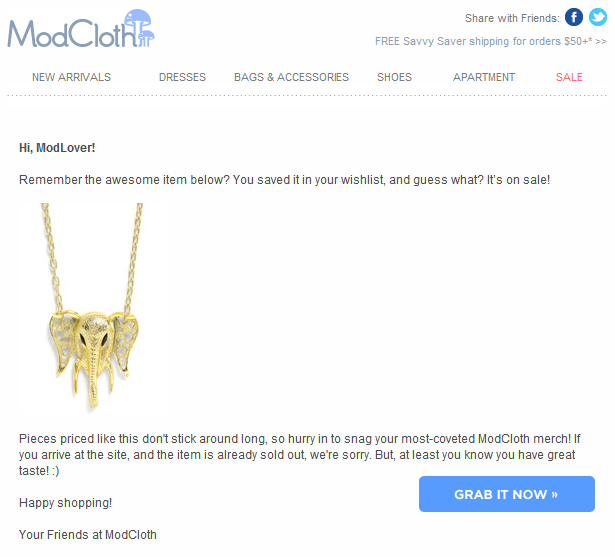


When customers are comparison shopping or unwilling to complete the purchase of something they like, price is often a factor. This remarketing campaign is genius because it addresses that purchase blocker by alerting me that something I wish I could have is now on sale. If I wasn't willing to buy it for its original price, maybe I'd be interested to "Grab It Now" for the sale price. Brilliant!

3) Last Chance to Purchase


Just like ModCloth lets you know when something on your wishlist is on sale, they have a remarketing campaign that alerts you when something on your wishlist is almost out of stock. Sometimes a sale can be enough to incite a customer to purchase; but maybe the urgency of an item selling out is enough for those items that are so popular you don't even need to put them on sale!


Emails like these are not only great because they encourage a purchase, but they also do so in a way that actually comes off as customer service. You're doing your customers a favor in this email -- getting in touch with them to let them know something they like won't be available soon. Personal service, meet 2012 ecommerce -- we think you two might have a lot in common.

4) Repetitive Behavior


Target people's past buying behaviors to get in touch with them right at (or ideally, a little bit before) the moment they'll need to make a purchase. This is a great email remarketing technique for businesses that deal with monthly, quarterly, or yearly purchases -- like an online contact lens retailer, for example. Since they know when you last bought contacts, in what amount, and how long that amount will last, they can perfectly time an email remarketing campaign to hit at your time of need.

But there are a few other creative applications for this type of remarketing campaign, too. Just take a look at how 1-800-Flowers targets holidays for which their products are a great fit in their 2012 Mother's Day campaign. Even though I didn't buy flowers from them at Mother's Day last year (calm down, I used another vendor -- I'm not an animal!), I've purchased with them for other holidays. So it's smart of them to recognize Mother's Day as an opportunity for me to buy flowers from them instead of another competitor, since they know I'm likely to buy flowers from them for other holidays.


You can also do a mash-up of the two concepts we just discussed, like Pottery Barn did below. They took a more subjective look at customer buying behavior, and matched it up with the time of year to come up with this remarketing campaign. Since I purchased items from their outdoor collection last spring, I might be interested in doing so again this year.


 5) Add-On and Related Item Suggestions


You know when you go to Amazon.com and they have a whole list of items they think you might like based on the product page you're viewing? Some of them are add-on items (products that would make the one you're looking at function better); and some are related items (products that other shoppers who purchased an item tend to like).

You might not have an algorithm running like Amazon does to tell you these things (or maybe you do!) but you can still take your product knowledge and apply it to an email remarketing campaign that recommends buyers purchase add-on and related items. Take a look at how Buy.com did it below.


(Tip: If you do have an algorithm running, you can use your purchase confirmation email -- an email that typically has a very high open rate -- as an opportunity to include these recommendations.)

6) All Your Friends Love It!


We've already talked about the importance of social proof and user-generated content in your marketing; why not include it in your next email remarketing campaign? Send an email like ModCloth's below (I told you they'd make multiple appearances today) that shows what others are saying about products you might like based on your past purchase history. These testimonials come from the product review section of their website, but you could also pull from customers' tweets and Facebook status updates that praise your product -- I've received an email from these folks that does just that in the past, too!


7) Back in Stock


Finally, consider sending an email alert for the products your customers wanted, but couldn't quite get their hands on, like you see below. There are two ways to approach this particular email remarketing campaign, both of which hinge on the fact that you keep out-of-stock products on your website.

The first is to add a module to your website for products that are out of stock that lets customers put in their email address, and ask to be alerted when a product's inventory is restocked. The other method, which can be combined with the previous one, is to alert customers who had an item on their wishlist but didn't complete the purchase before an item sold out. In this instance, you know a customer loved an item, but just didn't get to checkout in time; a remarketing campaign that let them know their much-coveted item is available would be another great way to deliver some seriously personal service!


View the Original article

Read more...

Why You Need Social Media, Even if Your Customers Don't


Well, here's the thing: your customers probably are on social media. Can any B2B company make the case that its target audience isn't on LinkedIn? Are there B2C companies without potential customers on Facebook? I guess it's possible, but it certainly won't stay that way for long. 79% of US adults use social media (if you were tuning into our webinar with Facebook today, you would have heard that very stat)! And eMarketer predicts there will be 1.43 billion worldwide social media users in 2012. Wow.


But this blog post isn't an attempt to convince you that your future customers are using social media. It's an attempt to convince you that there are many other reasons why social media is a crucial component of a well-rounded inbound marketing strategy -- and they have nothing to do with "engaging" with your target audience.

So let's pretend that your customers aren't on social media, or that you work for someone who thinks they aren't and, as such, doesn't see the point in investing in a social media marketing program. We all know how hard it is to convince non-believers of the importance of social media, so this post will serve as your guide for having that conversation. Here's how you can make the case for social media marketing to your boss -- even if he or she doesn't believe your target audience is using social media!

1) Social Media Activity Impacts Your Organic Search Presence


If you're investing in content creation, it would be a shame not to get it any visibility in organic search. Social media plays a bigger role in the visibility of web pages in search engines every day. In fact, Google even started to incorporate Google+ status updates into its search engine results; we've even written an entire blog post about how to use Google+ to gain better visibility in search engines!

Turns out, search engines take cues from social media activities -- like when someone shares content from your website on Twitter, for example -- to determine the relevancy and authority of your site. So the more people that "vote" for your content on social media, the better your search engine visibility becomes. Give them the chance to vote for it by publishing blog posts, ebooks, buying guides, case studies, testimonials, and other interesting content to your social media accounts, and reap the benefits of better search engine rankings as a result.

2) You'll Have More Control Over Your Online Image


Speaking of search engine rankings, maintaining an active social media presence for your brand lets you dominate the SERPs in another way, and to meet another end -- a better reputation (or at least the appearance of one). Let's say someone hears about your company and is curious about who you are; what you're like; and whether you're generally "good people." If someone conducted a Google search on you right now, what would come up? Here's what comes up for HubSpot, for example:


Notice all those orange call-outs? Those are some of HubSpot's social media accounts, and they appear in the top 10 results for a HubSpot query. That's because these sites have a lot of clout with search engines, and the results are typically relevant for someone trying to learn more about a company or brand name. That also means, however, that a big review site like Yelp! (have you ever performed a search for a restaurant, for example?) is very likely to come up as another relevant, high authority site. In fact, Socialnomics reports that 25% of big brands' search results return content from things like review sites and blogs.

Wouldn't you rather leverage the power of big social media sites like Facebook, Twitter, Google+, YouTube, Flickr, LinkedIn, etc. that you manage over third-party review sites over which you have little control? Plus, the appearance of your social media accounts will only give interested searchers access to more of your great content!

3) User-Generated Content is More Critical Than Ever Before


Which brings us to user-generated content. According to eMarketer, 65% of users ages 18-24 consulted the information they found about brands on social networks when making a purchasing decision, and a whopping 2/3 of consumers use search engines when researching a purchasing decision according to eConsultancy. Sounds like there's a good chance your audience is part of one of those groups. Social media is a great way to get that user-generated content you need out on social networks and in search engines to an audience who clearly cares about it.

4) You'll Gain Industry Clout


Okay, let's say your customers really aren't part of the 2/3 of consumers that care about what they read about you in search engines, and they're not part of the 65% of millennials who care about your social media presence. There are still your colleagues, thought leaders, conference organizers, future employees, potential business partners, journalists, and marketing & PR professionals using social media on a daily basis. These power players expect to not only find you, but also learn from and communicate with you using social media. And frankly, you should expect the same from them!

Use social media to make connections that could help your business, learn from people, get selected for speaking opportunities, find sponsors for your events, etc. Your activity in social media will give you the clout and visibility you need to get identified and selected for important opportunities -- especially if your competitors haven't jumped on the social media bandwagon yet.

5) Other Companies' Customers Are on Social Media


Speaking of identifying new opportunities ... other companies' customers are on social media. Could any of those business' product or service offerings overlap with yours? Or perhaps their audience opens up another part of the market you haven't tapped yet. It would certainly behoove you to get visibility with these companies and their networks on social media. Share their content, build relationships by interacting with them, create great content that speaks to these companies and their audiences -- this will get you exposure to a whole new audience that could yield new partnerships, gain you referral business, and open up a new audience to whom you could sell!

For example, let's pretend HubSpot's audience isn't on social media (hah). But there are a ton of marketing agencies who have clients who would benefit from some marketing software! If we are active on social media and engaging with those marketing agencies -- sharing their content, publishing content they would like to share with their audience, and having conversations with their fans and followers -- we could build a mutually beneficial relationship with the agencies, get more referral business, and tap into a whole new audience at the same time.

6) Social Media Helps Expand Your Overall Reach


The agency instance we just described above is also an example of using social media to expand your overall reach. Let's break down the importance of reach for your business in more detail, though, and explain how social media helps you achieve it.

Reach is the concept that all of your fans and followers have their own fans and followers. So if one of your Twitter followers has 100 followers, shares one of your tweets with a link to your blog post in it with her 100 followers, the reach of that tweet and blog post has expanded to those 100 people -- many of who don't know you yet. So even if that one Twitter follower of yours isn't part of your target audience, there's a chance one of the 100 people she shared your content with are.

There's another benefit to having wide social media reach. Remember in the beginning of this post when we talked about how important social media was for your organic search presence? That's exactly why you need a ton of social reach; even if your social media followers never convert into customers, they can still share your content and amplify how many other people see that content -- an indicator to search engines that you're important enough to rank in the top of the SERPs.

This is why we at HubSpot encourage employees to be active on social media -- it helps us expand our reach! Because we celebrate employees using social media, more of them tweet out our content (like this blog post, for example!) and thousands of people that aren't HubSpot's fans and followers yet get access to our content. In this way, every single employee of yours has the potential to bring their own book of business -- even if they're not in sales or marketing.

7) It May Cost Less to Generate Customers on Social Media


One way you should be measuring the effectiveness of your marketing is based on the cost to acquire leads and customers, and how much those leads and customer are worth to your business. While this may not be the case for every business, the following scenario is an important one to consider.

Let's say your social media investment only generates 1 new customer per month. Take some time to look at the cost associated with generating that one new customer compared to other marketing channels. Your cost of customer acquisition (COCA) for email marketing, for example, may be much higher than your COCA for social media -- email marketing might require expensive software, more staff to manage it, and content creation man hours while your social media marketing program could be executable with no software investment and just a couple dedicated man hours per week.

Email marketing may generate more customers than social media marketing; you need to solve for both volume and efficiency, so both would still be crucial components of your marketing strategy. But this is why social media often gets a bad rap. Marketers often focus on fluffy engagement metrics like comments and likes, and neglect to consider the end goal of all of their marketing efforts -- customer acquisition.

8) Social Media Amplifies the Effectiveness of Your Other Marketing Efforts


Even if you don't rely on social media solely to generate leads and customers, using it will help your other marketing initiatives be more effective. In fact, social media helps just about everything: organic search, email marketing, blogging, even online and offline events. For example, you can add social sharing buttons to your emails and blog posts to encourage content sharing and expand your reach. Or you could use social media to generate buzz for an in-person event -- it's common for live events (and webinars, too!) to make use of a hashtag to encourage participation and get more people talking about your company and your content.

We've written an entire post about how to integrate your marketing if you're interested in learning more about the tactics, but it's no coincidence that social media makes quite a few appearances on that list.

9) By the Time You're Ready, It Might Be Too Late


Okay, maybe you're not ready to use social media today. But it would be short-sighted to think your audience will never be on social media (see Sarah Palin's predicament to the right), or that you won't want to use it more actively in the future. That's why it's a good idea to secure your social media account names now, and have enough activity on those accounts so that emerging businesses with the same name can't petition the social networks to take over your name. Or worse -- claim the name before you had the chance to grab it.

10) Your "Irrelevant" Social Media Audience Could Turn Into Your Target Audience


People change, man. The audience you build on social media will go through several career changes, industry shifts, acquire new hobbies, make new friends, change religions or political leanings, have children, get divorced, retire ... you get the point.

Alternately, you could change. Your business may expand product and service offerings, identify an opportunity in an emerging industry, or maybe you're just so good at your job that you nurture your social media leads into wanting your product or service.

In any event, if even one of these changes takes place, wouldn't it be great to already have your social media audience built instead of starting from scratch? If baking soda was invented in 2012, Arm & Hammer would be glad to have a social media following beyond just bakers, as people have discovered that it can be used for many other applications -- from science experiments, to personal hygiene, to cleaning, and more.

Why do you think it's important to be on social media, regardless of how much of your target audience is?


View the Original article

Read more...

My Visitors

  © Blogger template Shush by Ourblogtemplates.com 2009

Back to TOP